WESTBOURNE
A village history in West Sussex
Home | Personal | Church | Scouts | Schools | Ambrose | Sketchbook | Workhouse | Census | Memories | Yesteryear | Publications
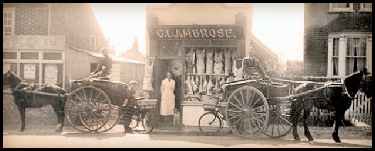 During my teens in addition to being a paper boy for Cripps the
newsagent I started as an errand boy for Ambrose the butcher. It was
just a few yards across the road so no great journey. Tasks ranged
from helping in the shop to making deliveries on a bicycle with a
large basket on the front. One route was down through the village,
along Southleigh Road, up Hollybank Road and back to the shop.
Shorter journeys were up to the top of Monks Hill to Miss Bennett
and Miss Fogwell. Their corned beef meat ration was just enough for
a sandwich. My worst days for deliveries were twofold. Firstly, when
stopped by the Weights & Measure officers. They would check the
weight for each customer with the delivery ticket. Unfortunately
they did not put the items back in the same order for delivery.
Secondly when it was raining hard requiring a change of clothes on
returning to the shop. There was also a Friday evening delivery with
either Mr or Mrs Ambrose in the van. This took us out via Aldsworth
to Churches Corner farm , Funtington and then onto East Ashling
towards Chichester. My 'posh' delivery was to the tradesman door on
the Sennicotts estate to a Bowes-
During my teens in addition to being a paper boy for Cripps the
newsagent I started as an errand boy for Ambrose the butcher. It was
just a few yards across the road so no great journey. Tasks ranged
from helping in the shop to making deliveries on a bicycle with a
large basket on the front. One route was down through the village,
along Southleigh Road, up Hollybank Road and back to the shop.
Shorter journeys were up to the top of Monks Hill to Miss Bennett
and Miss Fogwell. Their corned beef meat ration was just enough for
a sandwich. My worst days for deliveries were twofold. Firstly, when
stopped by the Weights & Measure officers. They would check the
weight for each customer with the delivery ticket. Unfortunately
they did not put the items back in the same order for delivery.
Secondly when it was raining hard requiring a change of clothes on
returning to the shop. There was also a Friday evening delivery with
either Mr or Mrs Ambrose in the van. This took us out via Aldsworth
to Churches Corner farm , Funtington and then onto East Ashling
towards Chichester. My 'posh' delivery was to the tradesman door on
the Sennicotts estate to a Bowes-
It was always a hectic business particularly for
me in holiday time as a teenager in the school holidays. While Mr or
Mrs Ambrose was busy in the shop serving customers Harrry Goble and
I were working out the back preparing joints, skinning rabbits and
gutting chickens. Mondays were set aside for cutting up over a 100
pounds of meat for beef or a side of pork for sausages. This was
then mixed with salt, pepper, herbs and bread crumbs and minced
together. The next stage was to feed this mixture in a hand machine
to produce yards of sausage skeins. These were then doubled back,
twisted into pairs at about 8 sausages a pound. This task could take
all morning and if demand was such another batch would be made later
in the week. The quality of these sausages was such that people
would travel miles to buy them. In fact his premier pork sausages
went as far apart as Devon and Scotland in my later married
life.
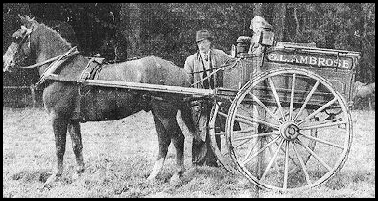 There was also deliveries across country by horse and cart made by
Harry. The photo shows Sandy the horse, Harry Goble and in the
driving seat Madeline Ambrose. One delivery round went up to one of
the cottages on the Stansted Estate, across farm tracks to homes in
West Marden and returning via Walderton. When on holiday I used to
accompany him and on a few occasions was allowed to make deliveries
on my own. Another disaster occurred when making a delivery to
Woodmancote similar to one experienced by Harry elsewhere. I was
going up the hill from the old slaughterhouse when the back trap
door opened and deposited my delivery on the road. Fortunately the
tray remained intact keeping the orders from spilling out. The fun
part for me was after returning to the stables and taking off the
harness. This was riding Sandy bare back to the fields that were off
the road to Aldsworth. Catching him again for another delivery could
be tricky. He could dash off as far a he could go or eventually be
tempted to take a meal of oats out of a bucket for a halter to be
secured. Then another bare-
There was also deliveries across country by horse and cart made by
Harry. The photo shows Sandy the horse, Harry Goble and in the
driving seat Madeline Ambrose. One delivery round went up to one of
the cottages on the Stansted Estate, across farm tracks to homes in
West Marden and returning via Walderton. When on holiday I used to
accompany him and on a few occasions was allowed to make deliveries
on my own. Another disaster occurred when making a delivery to
Woodmancote similar to one experienced by Harry elsewhere. I was
going up the hill from the old slaughterhouse when the back trap
door opened and deposited my delivery on the road. Fortunately the
tray remained intact keeping the orders from spilling out. The fun
part for me was after returning to the stables and taking off the
harness. This was riding Sandy bare back to the fields that were off
the road to Aldsworth. Catching him again for another delivery could
be tricky. He could dash off as far a he could go or eventually be
tempted to take a meal of oats out of a bucket for a halter to be
secured. Then another bare-
 The shop was only part of the Ambrose business, another was the
slaughterhouse at the bottom of his garden together with stables,
tack room and pig sties. He also had a couple of ferrets who enjoyed
the occasional chicken head. During the war and after when meat was
rationed extras were obtained by a group of villagers who formed a
pig club. With the support of Mr Ambrose the pigs were housed in
sties that backed onto Ellesmere Orchard into which the manure and
straw was dumped to mature. Over several months the club members
collected swill comprising household scraps from friends and
neighbours. Each day the swill was mixed with water and cooked in a
large steel pot heated by a log fire. The timing was that the pigs
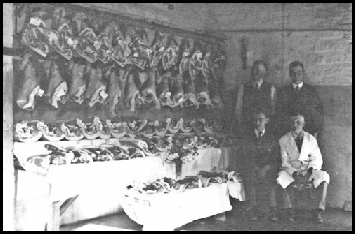
were fattened for Christmas when they were slaughtered. The picture
shows the joints of pork proudly displayed by Mr Ambrose, Mr Todd
and other helpers. How the joints were allocated to club members
cannot be recalled. What is remembered is that our regular favorite
joint was a hind leg, and very good it was too. We were told the
only bit of the pig you couldn't eat was the squeak!
The shop was only part of the Ambrose business, another was the
slaughterhouse at the bottom of his garden together with stables,
tack room and pig sties. He also had a couple of ferrets who enjoyed
the occasional chicken head. During the war and after when meat was
rationed extras were obtained by a group of villagers who formed a
pig club. With the support of Mr Ambrose the pigs were housed in
sties that backed onto Ellesmere Orchard into which the manure and
straw was dumped to mature. Over several months the club members
collected swill comprising household scraps from friends and
neighbours. Each day the swill was mixed with water and cooked in a
large steel pot heated by a log fire. The timing was that the pigs
were fattened for Christmas when they were slaughtered. The picture
shows the joints of pork proudly displayed by Mr Ambrose, Mr Todd
and other helpers. How the joints were allocated to club members
cannot be recalled. What is remembered is that our regular favorite
joint was a hind leg, and very good it was too. We were told the
only bit of the pig you couldn't eat was the squeak!
A few years later when I became his errand boy my experience in the
slaughterhouse began. The team, if that is the right word, was Mr
Ambrose the registered slaughterman, a helper whose name cannot be
recalled, Harry Goble and me. Most of the animals slaughtered were
pigs, although there was the occasional goat from a private owner.
The morning of the day for slaughter was started filling the large
coppers with water that was heated to boiling point. In the centre
of the slaughter room, shown above, was a very large domestic bath
that was filled with the boiling water. After a pig was killed its
throat was cut and hung up to drain out all the blood. It was then
lifted into the bath and the hot water softened the skin to allow
the hair to be easily removed together with its toenails. It was
then hung up again and cut from throat to tail. It was my task to
collect the innards in my arms and transfer them to a bench for
cleaning. The tongue, lungs, heart and liver, called the pluck, was
then removed all connected and hung on a hook. My next task was to
clean the contents from the small intestine, called chitterlings,
for making into a meal for the dinner table. Meanwhile the pig
carcase was hung on a rail and would stay there for inspection and
then for jointing in the shop. Some of the hind legs were salted for
a few weeks in a bath and then smoked in a kiln next to the shop.
Before
Christmas Mr Ambrose would visit the livestock shows and buy one of
the prize cows as a special treat for his customers. The dressed
carcass together with turkeys, geese and chickens were a major
display in his shop and attracted much admiration and visitors from
afar. Christmas was a busy time for me and Harry, who killed the
birds, and we spent hours plucking them.
Towards the end
of my employment Mr Ambrose started to branch out from pigs to
cattle. The first batch of about 15 cows arrived at Emsworth Railway
station. They were then walked from there to Westbourne by road. My
task was go ahead, warn traffic and ensure that gates were closed
and guide the cattle past side roads and other openings. A task that
we all achieved successfully. For whatever reason, I found the
killing of cattle unsettling. Perhaps it was because he had his own
few cows that were used for milk and butter. I would collect them
from the fields where Sandy the horse grazed and return them later.
They had names and it can be understood how farmers get attached
their animals and are sad to see them eventually move on.
